
Treasure Hoard - January 2026
Saving music videos, history not written by the victors, doomerism, imagine no religion, the tween Michaelangelo, etc.

And now for the links...
Lydia Wei, presumably in her best Smokey Bear voice, opines about how Only YOU Can Save Music Videos for A.V. Club. After narrating the rocky path music videos have taken in the last 20 years, she throws out some ideas for how to contribute to the survival of the format.
Text your mom and tell her you love her, then send her the link to your favorite latest music video. Resist the temptation of TikTok (or, God forbid, Instagram reels, though if you’re at that point you might be beyond saving). Invest in 10-minute music videos. Reward creativity and ingenuity. Punish short-form mediocrity and AI slop…
I’m trying to do my part by posting a music video most Saturdays. I don’t get a lot of comments or feedback on the posts, but it’s a satisfying way to express my appreciation for the format. It’s hard to get someone to listen to a whole album, but if you can get them to check out a video, it gives them more of an insight into an artist than the song alone.
History is written by the victors. One instance of this that always bothered me is the picture that you get of William Jennings Bryan from the portrayal of the Scopes trial and the movie Inherit the Wind. It’s easy enough to criticize Bryan’s defense of pure creationism as opposed to evolution in the trial. When you understand the context, though, his opposition to evolution/natural selection starts to look a little more reasonable.
Gillis Harp writes about the complexity of the real narrative for Mere Orthodoxy.
Contrary to the common caricature of Bryan, his opposition to Darwinism often focused on the dangers of social Darwinism’s scientific-sounding argument used to support cutthroat competition and laissez-faire economics. Bryan feared, in Kazin’s words, “a society run by Darwinists [that] could justify a law barring the feebleminded and poor from having babies and could engage in endless wars of conquest.” In 1925, his naive defense of a literal six-day creationism at the infamous Scopes ‘Monkey trial’ made him the object of widespread ridicule.
Don’t forget, these were the times of eugenics, and the popular theories of the day were used to defend such practices. Bryan had a moral opposition to such practices and sought to limit the spread of theories that enabled them.
Emma Collins writes on her blog A New Heaven about trying to maintain positivity and not succumb to doomerism. For her, it’s a functional framework.
I’ve been thinking a lot about doom lately — about “doomerism,” or any kind of similar fatalistic posture. And most of you will know by now that I don’t believe in it at all. I can’t. For people like me in recovery, it doesn’t work. We can’t succumb to that kind of thinking if we want to stay well.
This sentiment may well apply to many people who aren’t in 12-step programs. Some of my chronic health issues manifest themselves in greater force if I’m carrying a lot of negative feelings.
The line in John Lennon’s “Imagine,” where he implores the listener to imagine no religion, has always made me squeamish. As Tom Holland points out in his book Dominion, the words of this song, penned by a singer living in a large house behind gates, can seem a bit disingenuous. Not to mention that it feels like an attack on people of faith.
Maybe Lennon’s vision isn’t so far out of line with traditional Christian eschatology, though. D.N. Keane considers the book of Revelation for The Anglican Way.
This is what John saw, or rather didn’t see in his Apocalypse: ‘I saw no temple therein: for the Lord God Almighty and the Lamb are the temple of it. And the city had no need of the sun, neither of the moon, to shine in it: for the glory of God did lighten it, and the Lamb is the light thereof’ (Rev. 21:22). The culmination of John’s religious vision is the abolition of religion, because all that religion aims to effect – to redress of the alienation of humanity from God, of person from person, and the human person with her inmost self – will have come about, not partially and imperfectly through preaching and ritual, but completely and fully, in spirit and in truth.
Keane sees the abolition of religion and the need for it to bridge the gap between God and man as having been accomplished in the age to come.
While I’ve read many such thoughts about resisting the pull of the phone in the last few years, I like the way Isaac Greene phrases the struggle.
Though there are fewer things now than ever that I’m willing to be dogmatic about, I feel absolutely certain that there is no amount of putting your phone away that you will regret.
This particularly comes to mind as it’s nearing the time to go off to the land of Winken, Blinken, and Nod. I’m compelled to put down my iPad and go read to and talk with my son.
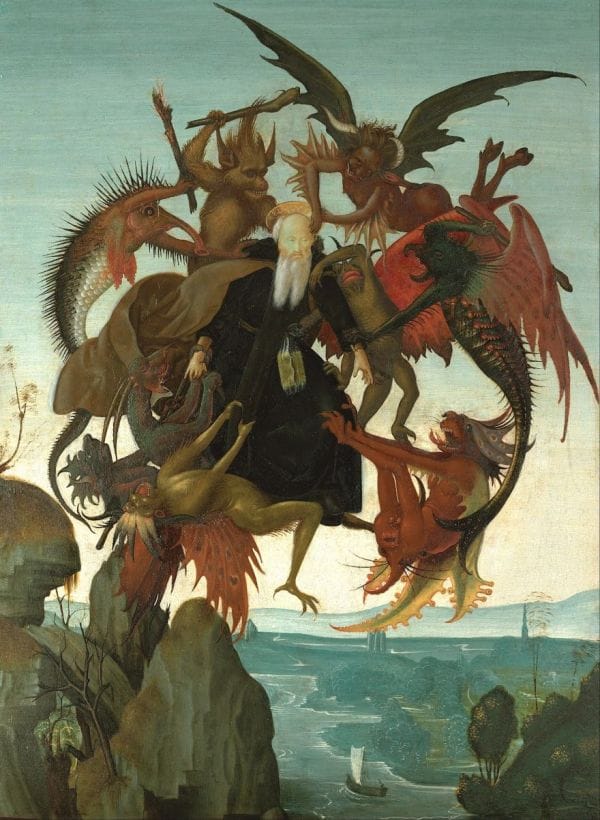
I just reread St. Athanasius’s account of St. Anthony fighting off the demons in his biography of the venerated desert father. Neatorama reveals a painting of St. Anthony in the act was done by a tween Michelangelo.
When you were in junior high, or middle school, you probably drew monsters or dinosaurs when you were sitting in class. Around 1487, Michelangelo drew demons, and painted them with oil paint. The work pictured here, titled The Torment of Saint Anthony has been identified as an early Michelangelo, painted when he was only 12 or 13 years old. The painting was never lost, but for 500 years, no one knew who the artist was, and it was classified as anonymous.
I used to draw band logos and similar stuff in my notebooks at that age.

Treasure Hoard
Sign up for Treasure Hoard to receive email digests in your inbox.