
Treasure Hoard - March 2026
It takes religion to make Star Trek, Anthropic vs. the Department of War, James Talarico's Christianity, the iPod comeback, retreating to the woods, etc.

You have been granted access, use your keyboard to continue reading...
James W. Lucas argues for Compact Magazine for the case that only religion can produce the kind of human flourishing that would be needed to create a future of the kind that is depicted in Star Trek. He specifically hones in on a topic that is hot right now: plummeting birth rates.
Returning to the world of hard data, while many moderns claim that economic hardship is their reason to postpone or forgo having a child, in almost all countries economic growth actually correlates directly with a decline in fertility. Further, generous government financial incentives and benefits such as free childcare intended to ease these supposed economic disincentives to child-bearing have proven ineffective in raising long-term birth rates. Therefore, even if we allow Star Trek its utopian post-scarcity socialist economy, based on demographic facts the society portrayed in this future history would presumably still have the low birth rates shown in the TV shows and movies.
The piece is well-thought-out conceptually and a challenge to many of our assumptions.
 James W. Lucas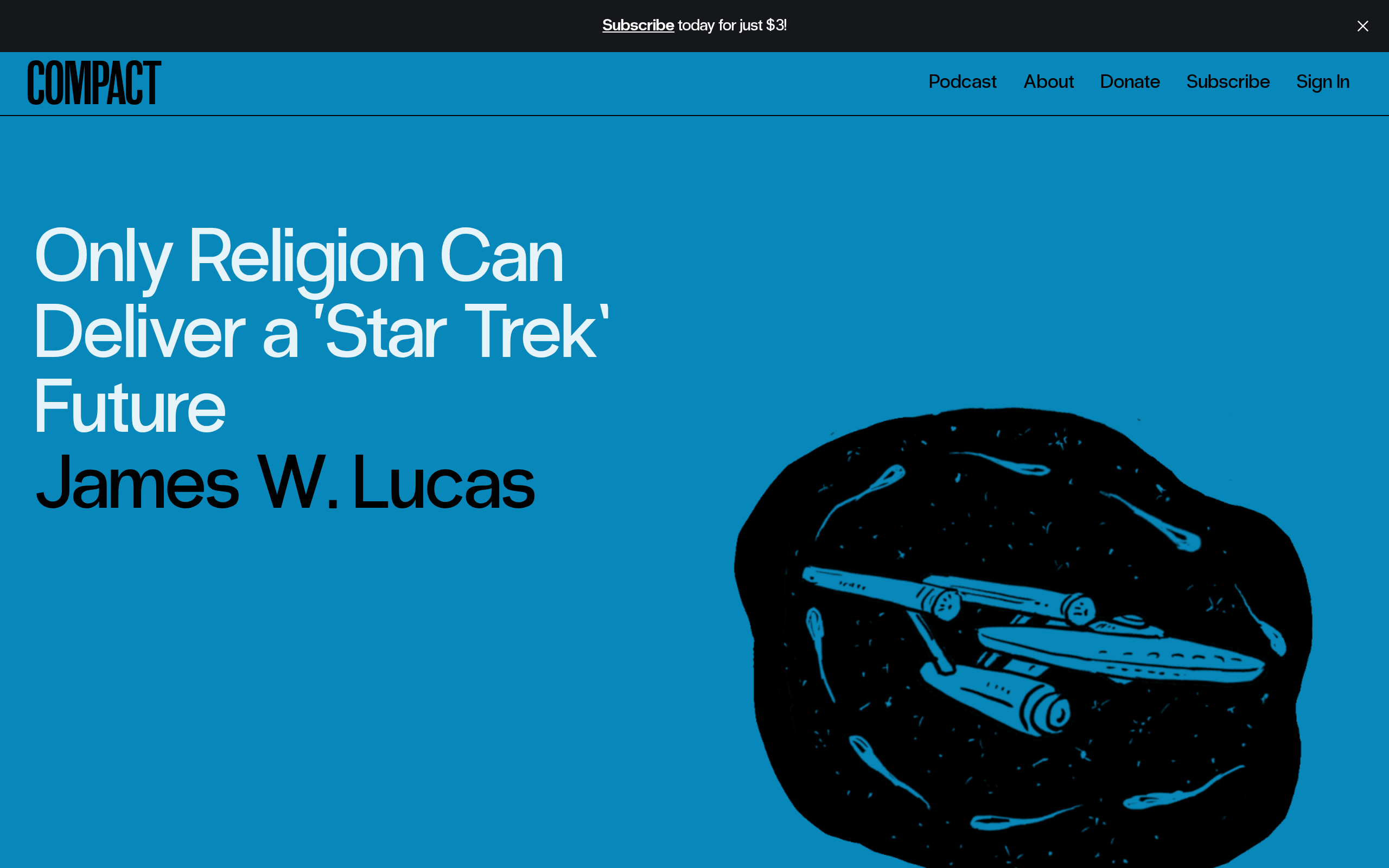
After Anthropic refused to cooperate with the government's demands for use of their LLM, OpenAI reached a deal with the U.S. War Dept. to use its software for "legal" purposes. Cade Metz from the New York Times reports on the particulars.
Under the deal, OpenAI agreed to let the Pentagon use its A.I. systems for any lawful purpose, a term required by the Pentagon. But OpenAI also said it had found a way to ensure that its technologies would adhere to its safety principles by installing specific technical guardrails on its systems.
OpenAI hasn't demonstrated that it even has guardrails to prevent its LLM from teaching teenagers how to commit suicide. We are supposed to believe it can stop the government from using the software however they please?
I haven't read much from the Stretechery blog by Ben Thompson over the years. Since everyone was linking to his piece on Anthropic and their refusal of the contractor clauses from the Department of War, though, I went through it.
At the same time, what is the standard by which it should be decided what is allowed and not allowed if not laws, which are passed by an elected Congress? Anthropic’s position is that Amodei — who I am using as a stand-in for Anthropic’s management and its board — ought to decide what its models are used for, despite the fact that Amodei is not elected and not accountable to the public. And, on the second point, who decides when and in what way American military capabilities are used? That is the responsibility of the Department of War, which ultimately answers to the President, who also is elected. Once again, however, Anthropic’s position is that an unaccountable Amodei can unilaterally restrict what its models are used for.
Thompson is referencing a standard functional democratic model as if that ensures the lawful use of AI. He knows, though, that we are not living under a standard democratic model with an intact rule of law. The current administration commits illegal acts and Congress is nowhere to be seen. They don't even factor in. Subsequently, the courts rule the action illegal, but it's usually too late because much damage is already done.
As a real example of how this technology could be used: Targeting civilians in fishing boats. Most legal experts would say it's illegal, but the executive branch would argue with that and say it's perfectly legal. Only later would the case go through proper jurisprudence and determine that the act wasn't legal. Too late for the lives of the civilians.
I like the Democratic nominee for U.S. Senate, James Talarico. He comes from a more progressive Christian background, and Lord knows the country needs a religious alternative to the right in politics. There are some problems with his approach, though.
As Jamie Wilder writes for Mere Orthodoxy, Talarico has his own views on Christianity that don't line up with orthodox belief.
The problem isn't that Representative Talarico is bringing his faith into politics; it's that he is bringing a counterfeit faith, one that would be completely unrecognizable to the global and historic Church. To accept the progressive dogmas Talarico attempts to baptize, one must ignore the witness of believers across every century, language, and hemisphere. Are we really so arrogant to believe that we are the first generation in two thousand years to finally "get it right"? And is it not incredibly convenient that our "new discovery" happens to coincide exactly with the encroaching sentiments of secular culture?
Christians in this country need politicians who put their faith first and model their politics after their convictions, not the other way around.
I first learned about James Talarico from reading the transcript of this interview with Ezra Klein. I found many of his points persuasive, but his argument for the Annunciation of Mary as making the moral case for abortion access is just gross.
Speaking of the religious right, Peter Wehner covers their current movements for The Atlantic. He gets a lot right, but some of his overall skepticism about faith in public life seems misguided.
There are shining counterexamples, of course, including people I have met along the journey who can authentically claim, “Thou and thou only, first in my heart; High King of Heaven, my treasure thou art.” But they are the exception, and it does no one any good to deny it. “Christianity has not produced Christlike people on any meaningful scale,” a theologian once told me. That is vividly evident in American politics today, but it is hardly the only domain in which that is true. And until it is less true, we have very little to teach the rest of the world.
While the quote from his unnamed theologian might look correct at this particular moment, it does not hold up historically. There were Christlike people at scale who put the concept of hospitals in motion. There were a sufficient number of Christians who fought to abolish the slave trade and to confront the issue of civil rights for all in this country. To forget these movements seems like an unfortunate obfuscation.
→ MAGA Jesus Is Not the Real Jesus
Kalley Huang writes for the NYT about a quiet iPod comeback. The primary reason for people dusting off their old devices is simple: They are single purpose.
The resurgence of the iPod is a sign that “people want digital that’s not connected, but not necessarily analog,” said Tony Fadell, a former Apple executive who helped create the iPod. If the choice is “1,000 songs in my pocket, or unlimited songs in my pocket and 1,000 notifications every hour,” people don’t want the latter, he added. “Apple should just bring them back — not the same way,” Mr. Fadell said. “I would do it differently. I would make it modern for the modern age.”
“We have so many devices that do everything,” Elizabeth Hernandez, 22, said. “A lot of the time, that gets overwhelming.” But the iPod is “one thing that has one purpose,” Ms. Hernandez said. She has a pink fourth-generation iPod Nano for her favorite songs at the moment and a silver seventh-generation iPod Classic that she downloaded all of her CDs onto. Now when she discovers new artists, like the pop band After, she listens to their albums in full, rather than skipping from song to song.
Single-purpose devices still have their place. I love my Kindle Paperwhite and do much of my reading (including web articles and blog posts) on it.
I have an old clickwheel iPod. It’s a beautiful device and in good condition. It won’t play my FLAC files, but it will play ALAC (Apple Lossless). I’ll have to look into whether I could get my portable DAC, an Audioengine DAC3, to work with the iPod. I would love to have a device that allows me to just focus on the music.
Derek Sivers founded CD Baby, an online distributor of independent music, but many on the indieweb know him as the inventor of the Now Page. The Now Page, which features what a given blogger is thinking about and is up to in their life, is a popular blog feature.
Sivers, in the tradition of Henry David Thoreau, decided to go and live in a cabin in the woods. He has no internet and no phone in the cabin. Presumably, much like Thoreau, Sivers, “went to the woods because I wished to live deliberately, to front only the essential facts of life, and see if I could not learn what it had to teach, and not, when I came to die, discover that I had not lived.” Furthermore, like Thoreau, Sivers travels to a nearby town to do the things he can’t get done at his cabin. In this case, he accesses the internet for about an hour each day or two.
Every day or two, I bring my laptop into town to get online for an hour. The time limit keeps me super-focused. I know why I’m there. I know what I need. I download emails and upload code. I post my questions to a bunch of AIs, and save the answers to read later.
I'm always interested in how much work can be done on our many computers offline, and the mechanisms to facilitate that disconnection.
Via Patrick Rhone
Starting with the scene of the dry bones of Israel in the book of Ezekiel, Bee Wertheimer attempts to answer the question of why video game skeletons put themselves back together for A.V. Club.
There is something beautiful about how some of the most eternal and unifying cultural phenomena derive from great disaster. In the face of unspeakable tragedy, when the flame of humanity flickers at its weakest, we turn to creation for salvation. And then those creations inspire more, spanning generations and centuries, influencing humanity throughout the world and across the ages. Art and culture unite us in our suffering, and, in spite of everything, we survive—like video game skeletons.

Treasure Hoard
Sign up for Treasure Hoard to receive email digests in your inbox.