Bishop Militia
Is arguing online about high Christology a frutiful activity?

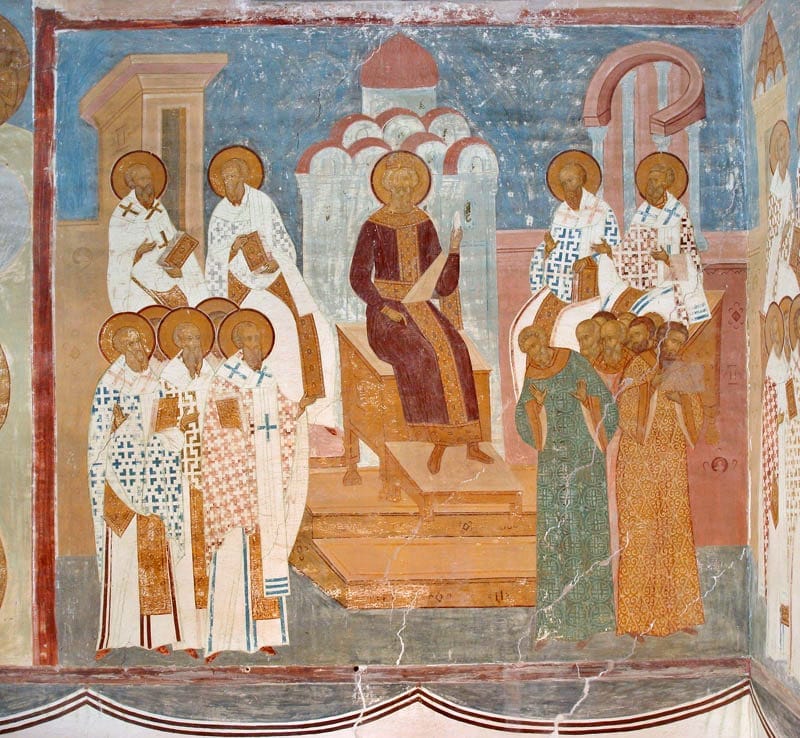
The commitment to Christianity as it was originally conceived and to guarding that tradition is something that I’ve always valued as a member of the Orthodox Church. However, one thing I’ve found within this particular expression of Christianity is a lack of ecumenical charity. This is especially true on YouTube. If you watch a couple of videos related to Orthodoxy, your algorithmic recommendations will quickly fill up with videos purporting to have a priest or some commentator “destroying” this or that version of Christianity. It’s almost a cottage industry within Orthodox Christianity.
Did Jesus indicate that Christians should spend their time making rivals out of those in different groups who revere him as Lord?
The words of Jesus in the ninth chapter of the Gospel of Mark:
“Teacher,” said John, “we saw someone driving out demons in your name and we told him to stop, because he was not one of us.”
“Do not stop him,” Jesus said. “For no one who does a miracle in my name can in the next moment say anything bad about me, for whoever is not against us is for us. Truly I tell you, anyone who gives you a cup of water in my name because you belong to the Messiah will certainly not lose their reward.
A couple of times over the last several weeks, I’ve attended an Anglican Church which is part of the ACNA (Anglican Church of North America).1 My own Orthodox Parish has become crowded to the point of barely being able to fit through the door. Any given Sunday would surely make the fire marshal sweat.
In response to my wandering, my Orthodox friend sent me this video purported to “destroy Anglicanism.”
In the video, Orthodox priest and author Fr. Stephen De Young is asked by a listener about what the podcast host, Cleave, calls the “one kill shot argument for Anglicanism.” This is how they talk on Orthodox YouTube, issuing “kill shots” against other Christian sects. The host injects his view into the answer, which consists of his “favorite” argument against Anglicans, which is that they claim to adhere to the ecumenical councils, but they don’t condemn the Coptic Christians as anathema.2
A Coptic condemned? You know, is Coptic theology condemned? You know, if they say because I asked this to Aiden Mattis who is an Anglican and he was like, I give them a pass. They’ve been persecuted, whatever. I’m like, well, this is my point. you don’t have the same faith as the Christians of the first thousand years of the church.
The host is actually chastising a Christian group for not being sufficiently disapproving of another one.
This is particularly typical of the internet-facing expressions of Orthodoxy. Drawing distinctions between different groups of Christians is a source of a lot of content on platforms such as YouTube.
As a Gospel-oriented Christian, it dismays me to see these things. Jesus was asked about the greatest commandment in the law.
Jesus replied: “‘Love the Lord your God with all your heart and with all your soul and with all your mind.’ This is the first and greatest commandment. And the second is like it: ‘Love your neighbor as yourself.’
Not once in the Gospels did Jesus say it was important to understand the division or unity between his divine and human natures. He never taught his disciples what to think about Miaphysitism. Nor did he ever indicate a human would even be capable of such understanding. Even a thorough modern autopsy couldn’t reveal such details, dependent on metaphysical and spiritual realities as they are.
I understand the importance of church councils in coming to conclusions about points of contention that divide the church. However, when you have the results of a church council 1500 years ago continuing to divide the group of orthodox believers today, I’m not sure that holding to its conclusions is in the spirit of Christian unity. It feels like losing the plot.
Orthodox writer Michael Warren Davies, who is embarrassed to be returning to Substack after rage quitting several months ago, writes about pointless religious arguments such as the ones I described.3 His topic is penal substitutionary atonement, an idea mostly attributed to John Calvin and sometimes thought of by the Orthodox as a heresy.
I related strongly to some of the points Davies presents.
This is one of the things that really drew me to the Orthodox. Clearly, they were committed to their ancient doctrines. It’s right there in the name! And yet they also seemed only to engage in theological arguments when absolutely necessary. This suggested all kinds of good things. A reluctance to cast pearls before swine. Commitment to peace, both inner and outer. Critical insights into how human beings form and change their beliefs. Proper emphasis on prayer, fasting, and good works. Intellectual humility. Above all, a deep reverence for mystery.
When I first visited an Orthodox Church with the Presbyterian confirmation class I was teaching, the clergy member assigned to assist us spoke with me after the official visit was over. He emphasized the belief among the Orthodox that not everything was explainable and that some mysteries are better left just as they are. I was immediately attracted to the idea that arguments should not be fought about the unknowable (particularly online, all the time). These discussions do nothing to increase the peace you share with your neighbor.
More and more it seems like that view is now in the minority.
With so many headstrong young men flocking to Orthodoxy, the internet serves as the place for them to prove their beliefs and allegiances. This seeps into what we would call meatspace and even the sacred “meatspace” of the churches. It’s disappointing.
- Which, coincidentally, has the same name as my current parish. ↩︎
- The First Ecumenical Council, in 553 A.D., marked a point of disagreement with the Coptic Churches over a point of high Christology about the relationship between the human and divine natures of Christ. ↩︎
- Who among us hasn’t inadvisably rage quit a service at some point? ↩︎

Canned Dragons Newsletter
Join the newsletter to receive the latest updates in your inbox.